
Stormy weather has kept me inside for my meditation. I told myself that the alarming noise of the storm was the sound of God’s creation. Still, it was unnerving as the rattling windows synched into a deep vibrating hum that turned the house into the Flying Dutchman’s cursed ship. As I have said, I am not a very good sitter.
Persisting, I chanted the Ephesians Canticle suggested by Cynthia Bourgeault for Advent. I used my own inartistic pointing, rising on the words that asked to rise and descending when they seemed to want to rest. I settled into my attempt at Centering Prayer.
I had forgotten to choose a word before I began. Although the words are supposed to be placeholders, windshield wipers as Cynthia says, I searched for one with meaning. “Come?” “Rest?” “Be?” Thinking of the sermons of Meister Eckhart, the center of the soul is not reached through the senses, it can’t be seen or heard or thought. Can it even “be”? Words were getting in my way.

Then in my mind I saw the icon by Andrei Rublev that Richard Rohr used as his way into a new understanding of the trinity, one in which we are all invited to the divine dance. He told us that scholars had proposed that what appears to be a small rectangular box in the icon was actually the site of a mirror to show that we, too, belong at the table.
That box came to me as I sat, not as a mirror, but as a tiny vault holding the very center of my soul. Teresa of Avila’s Interior Castle. Meister Eckhart’s unknowable home of that part of the soul that God alone can enter. And I settled into contemplation.
As thoughts came up and tried to crowd into the box–Will my printer work? Should I sell my zoom lens? –I simply took them out of the box and left it empty for God. No literal word, but a visual one: an empty home for God to come. I stand outside the box, not able to enter yet, but knocking, knocking. Perhaps God is on the other side, knocking back.
When I heard the ring of the singing bowl, I opened my eyes and across from my little meditation refuge under the stairs I saw what I had never seen before in all the twenty-four years I have lived in my house:
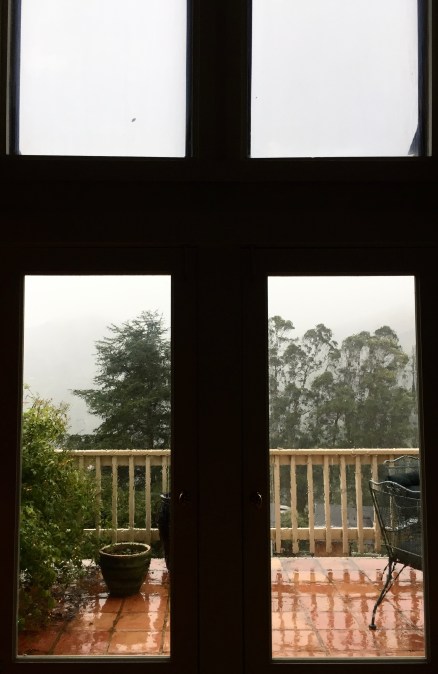
How is it that in contemplation we learn to see what we have always seen, yet have never seen at all?
 Contemplative Seeing