My life as a filter feeder

Trying to heal the suffering of the world through contemplation.


I was speaking with a couple of my circle group friends, and we all confessed that we had been having trouble with our practices.  We’d been procrastinating, doing really uninteresting and unimportant things instead:  classic avoidance.  So what was up?  It came to us that at this moment in time, there is just too much suffering in the world and we didn’t want to look at it.

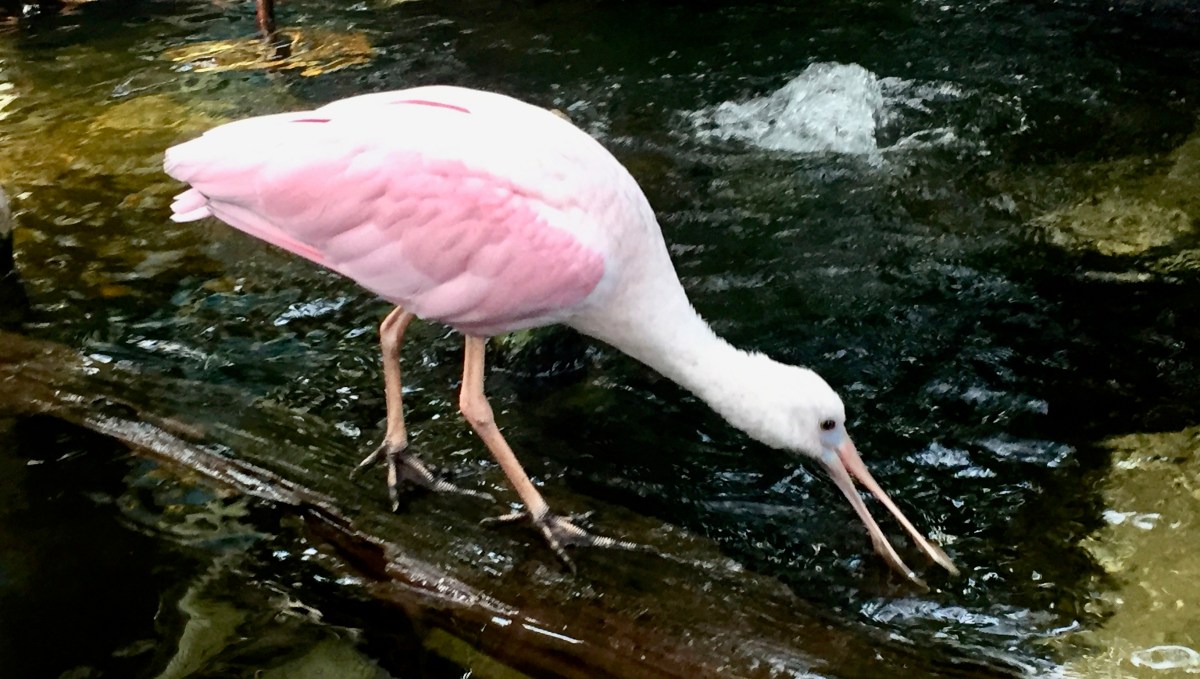
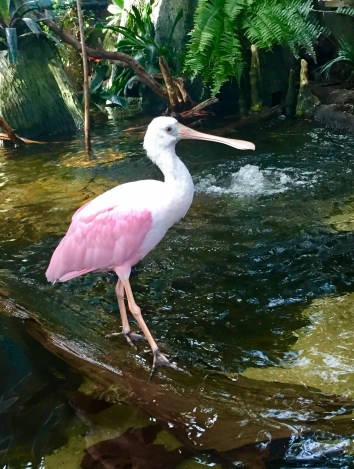
We made a pact that each day this week we would meditate on suffering.  We would take in the suffering of the world and breathe out light and love.  We would be filter feeders for the world, only purifying and clarifying the water of the human condition.   Like sponges. Or spoonbills.

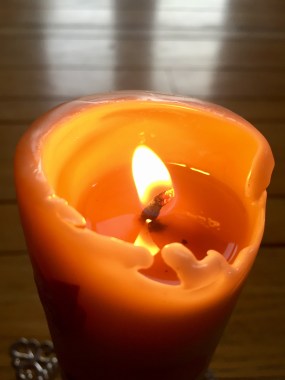
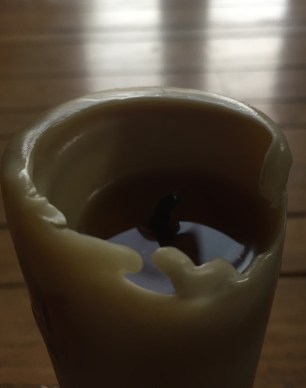
Today was the first day.  After a certain amount of time bustling around–positioning my meditation pillow, making a preemptive phone call, worrying if I would be warm enough or if the cold would be distracting, finding matches for the candle, oops, remembering my phone so I could time my meditation–I settled in to heal the world.
FullSizeRender

This is how it worked.  I started with Aleppo.  Then, I somehow found myself contemplating my circle group, thinking of each in turn and trying to feel what I knew of their pain.  But then, the circle came round to me and I asked myself, so, what are you suffering?  My mother.  I miss my mother.  She has been gone for thirty years.  Hmm.  Interesting.  Breathed it in, breathed it out.

I thought of those I know who are in need of healing:  a friend with breast cancer;  two friends with prostate cancer;  a friend whose husband is gravely ill but I don’t know the cause.  And then the circle came back around to me again.  Hmm, what am I suffering?  Well, it turns out I thought of a lot of things.  I breathed in the suffering, breathed out peace.

I had started to wonder about feeling all this suffering.  Most of the time, I just tamp it down.  In my practice, I certainly didn’t want to look at my own life, only at distant troubles like terrorists.  This afternoon, in preparation for this project, I’d read some of Thich Nhat Hanh’s writings about suffering.   Right off the bat, he tells us that, to the Buddha, “Our suffering is holy if we embrace it and look deeply into it.  If we don’t, it isn’t holy at all.  We just drown in the ocean of our suffering.”  A bit later he says, “We have to recognize and acknowledge the presence of this suffering and touch it.”  (The Heart of the Buddha’s Teachings, chpt 3).  So I can’t just ignore it.  I have to look at it.  Touch it.

As I reluctantly allowed myself to feel my own suffering (so much easier to heal the world!) my heart dropped, heavier and heavier.  And I saw at last the fundamental source of my suffering:  my distance from God.  My yearning.  My loss.

I sat with that.  And then, it just settled into breathing.

And when the bowl sounded, I was filled with deep peace.

So, it turns out I’m not much of a filter feeder.   I will continue to contemplate and inhale the suffering around me, but I understand that there is more work I need to do before I’m ready to save the world.  Meanwhile, I’ll just admire the spoonbills and find joy in their good work.
IMG_8662

An addendum on Thursday:  Ha!  Today in contemplation it came to me.  I was inhaling and exhaling, but leaving out the most important part of the equation:  God!  It is not I who bring peace and healing!  I can breath in and out all I want and nothing will come of it.  Today, in meditation, my bellows suddenly reversed and I was inhaling not suffering, but rather, God’s peace.  And I was exhaling it out into the world.  I can be a conduit for God’s peace!  And that is the best thing I can be.  Which, by the way, is exactly what my friend Claire said days ago. . .
FullSizeRender-1

Learning to be Icelandic

In Iceland, I was overwhelmed by the immense emptiness; the harmonies in basalt black, ice white, glacier blue, moss green;  the darkness;  the ice;  being alone in a huge landscape.  But something else struck me.  Everyone minded their own business.

I was a stinky driver, lurching through a crowded intersection in my rented manual Jimmy that died at least three times as I tried to shift.  Nobody honked.  Nobody.  The man stuck behind me passed and I slumped, but I couldn’t help glancing to my left to see if he glared at me or flipped me off.  He did neither.  He just drove past me looking straight ahead.

While standing as a pedestrian at an intersection, I stared at a driver waiting for him to motion me one way or the other.  He didn’t.  He just waited until I made my move.  I walked.  He waited.

Passing on the sidewalk, there were no idle interactions.  No one was unfriendly.  Anyone would help if asked.  It’s just that people seemed to keep to themselves.

Now, I should explain here that I have appointed myself hall monitor to the world.  “Excuse me, the line starts here.”  “There are other people ahead of you.”  “You should be grateful to your mother for that chocolate, not crying for more.”  Really, I am pretty embarrassing to be with.

I was mulling over the Icelandic acceptance, thinking it would be useful to adopt it into my regular life.  Life would be much more peaceful if I weren’t worrying about everyone else following the rules.  And, as these things happen, I was reading Thomas Merton’s New Seeds of Contemplation and came across this:  “One of the first things to learn if you want to be a contemplative is to mind your own business.  Nothing is more suspicious, in a man who seems holy, than the impatient desire to reform other men.”

Yeah, okay.  More work to do.

aurora

What’s in the box?

Stormy weather has kept me inside for my meditation. I told myself that the alarming noise of the storm was the sound of God’s creation.  Still, it was unnerving as the rattling windows synched into a deep vibrating hum that turned the house into the Flying Dutchman’s cursed ship.   As I have said, I am not a very good sitter.

Persisting, I chanted the Ephesians Canticle suggested by Cynthia Bourgeault for Advent.  I used my own inartistic pointing, rising on the words that asked to rise and descending when they seemed to want to rest.  I settled into my attempt at Centering Prayer.

I had forgotten to choose a word before I began.  Although the words are supposed to be placeholders, windshield wipers as Cynthia says, I searched for one with meaning.  “Come?” “Rest?” “Be?”  Thinking of the sermons of Meister Eckhart, the center of the soul is not reached through the senses, it can’t be seen or heard or thought.  Can it even “be”?   Words were getting in my way.

divine-trinity

Then in my mind I saw the icon by Andrei Rublev that Richard Rohr used as his way into a new understanding of the trinity, one in which we are all invited to the divine dance.  He told us that scholars had proposed that what appears to be a small rectangular box in the icon was actually the site of a mirror to show that we, too, belong at the table.

That box came to me as I sat, not as a mirror, but as a tiny vault holding the very center of my soul.  Teresa of Avila’s Interior Castle.  Meister Eckhart’s unknowable home of that part of the soul that God alone can enter.   And I settled into contemplation.

As thoughts came up and tried to crowd into the box–Will my printer work?   Should I sell my zoom lens? –I simply took them out of the box and left it empty for God.  No literal word, but a visual one:  an empty home for God to come.  I stand outside the box, not able to enter yet, but knocking, knocking. Perhaps God is on the other side, knocking back.

When I heard the ring of the singing bowl, I opened my eyes and across from my little meditation refuge under the stairs I saw what I had never seen before in all the twenty-four years I have lived in my house:

cross

How is it that in contemplation we learn to see what we have always seen, yet have never seen at all?

A Sea Chanty

Today I felt drawn to the sea, so I headed down the valley to Muir Beach.  I spotted this bench, the tiny shiny rectangle on the hill, and decided to claim it as my meditation spot.

img_6556

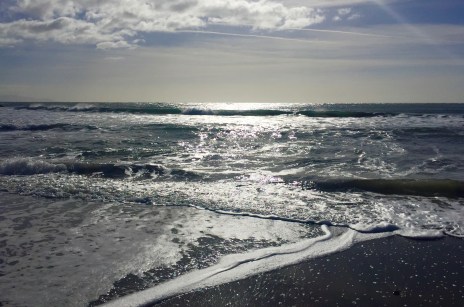
As I sat, listening to the sea and wind, tasting the salt, I would occasionally lift my eyes and take in the waves running ashore.  I watched the patterns of  spindrift and seafoam.   They formed and reformed, never the same shapes, always restless.

Looking farther out to sea, I could see swells and the surfers.  Beyond them, I saw the deep waters over the San Andreas Fault, the Farallon Islands, and at last, the churning seas of the ill-named Pacific Ocean.

img_6565

I wondered at the bubbles, and took in the immensity of the ocean.  I puzzled at their entanglement.  How does one beget the other?  Part of a chant by Paramahansa Yogananda popped into my mind:

Wave on the sea, dissolve in the sea; Wave on the sea, dissolve in the sea.  I am the bubble, make me the sea; I am the bubble make me the sea.

So, since it seemed to answer my question, I began to chant quietly.  Then, as I realized the wind and waves were loud and I was alone perched on my bench, I started to chant louder.  Soon, I sang full voiced into the wind.  Make me the sea, oh make me the sea!  I am the bubble, make me the sea!

I quieted into meditation but soon sensed some hikers lurking behind me, evidently coveting my bench.  I relinquished it and walked the beach, studying the bubbles and the sea.

img_6581

This is not a beach known for shells, but I found an intact keyhole limpet.  I gave it to a little girl in a periwinkle sweater who tucked it into her pocket.  She pulled out a bit of broken mussel shell to show me the amazing nacre hidden inside.  Our small shared joy surrounded us like sunlight.

Buzzing in the garden

img_4194-2

I was working in the garden.  It had been raining so there was fresh clover on the path and every plant glowed emerald green.  After carrying the last pile of cuttings to the compost bin, I decided it was time to try a sitting meditation.  I am not a very good sitter, being entirely too wiggly by nature.

And, naturally, just as I straightened my back and put my hands into their sabbath, and lowered my eyes . . . the chain saw started.  Exhale:  Me: I offer my brokenness and irritation to God.  Inhale:  God says: I love you in your brokenness and irritation.

After some time passed, I heard the strangest whirring sound. It was like a giant hummingbird.  Eyes closed, I turned my head this way and that to locate and identify the bird that made that sound.  Then, with laughter, I realized it was yet another electric saw breaking the silence.

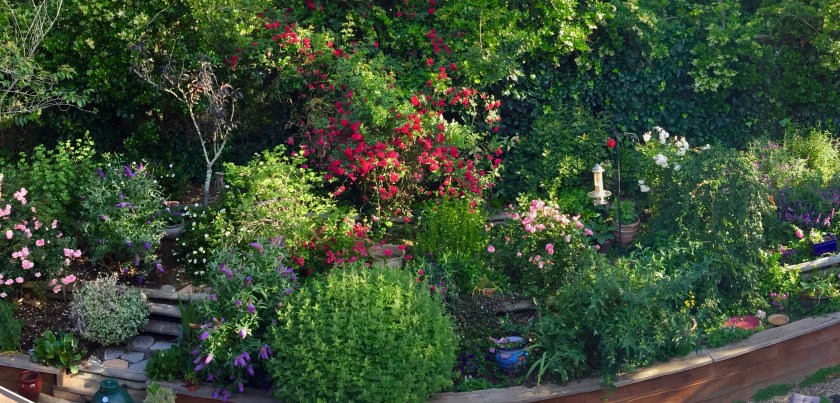
When I finished my sitting, I opened my eyes and took in the roses, the perennials, the vines that faced me in the garden.  There they were:  companions, friends, sending out love in every direction!   For years I have cared for them and nursed them through droughts and mulched their soil.  Now here, for the first time, I saw that they loved me back!  A garden full of stalwart friends, blessing me, feeding me.

img_4319-2

Welcome, friends!

What the rocks told me

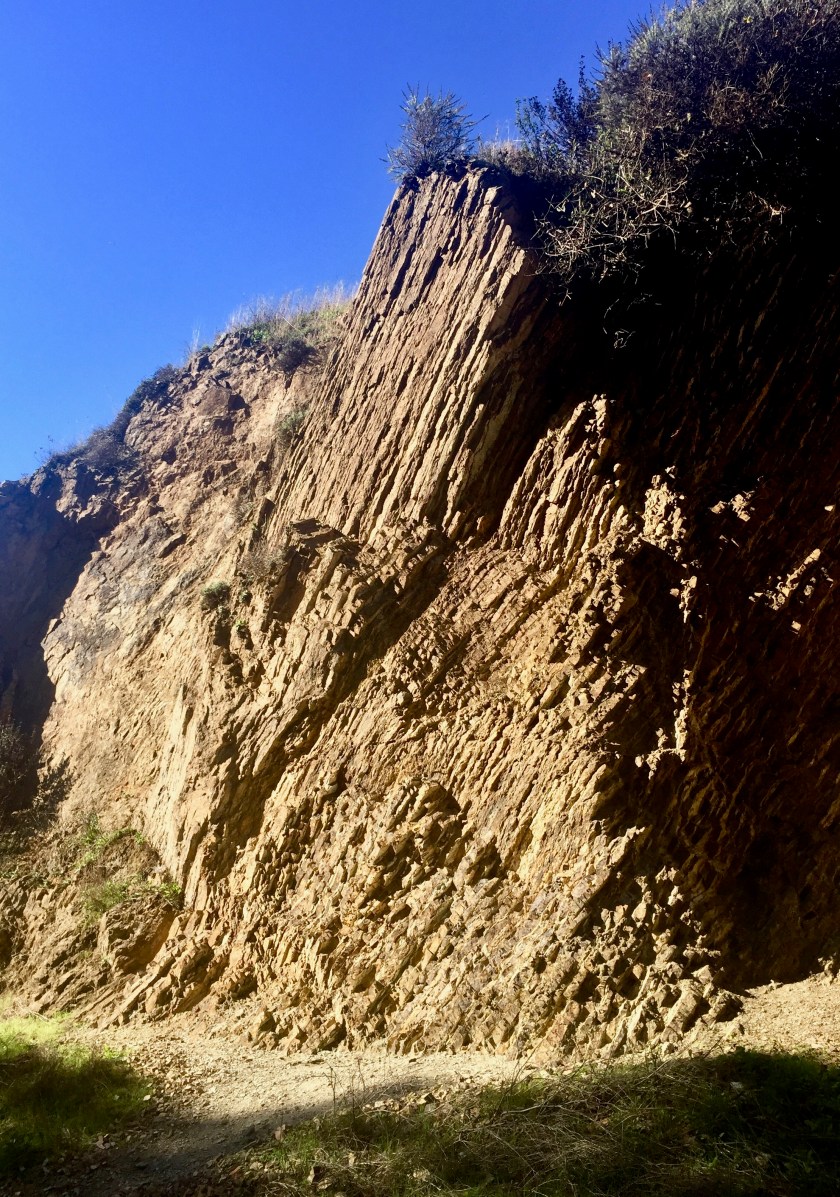
As I was walking, I saw a wall of stone. It had grown in sober layers, lying politely horizontal for millennia as a slow accretion of sandstone built it massive and immoveable.

img_6368

Then suddenly, with some violent burst upending the earth’s crust, part was thrust giddily skyward while part lodged deep into the unbreathing earth.  The stone said, “Fear not: neither the heights nor the dive!   Sometimes we are turned topsy turvy and then we either get a better view, or we learn surprising secrets.  All shall be well.”

I saw another face of stone.  This one said to me, “Aha! I see that your face, like mine, is deeply lined.  We have seen life, you and I.  Those smooth young stones, they don’t know what they’re in for.  Don’t worry about the wrinkles. And all shall be well.”

img_6511

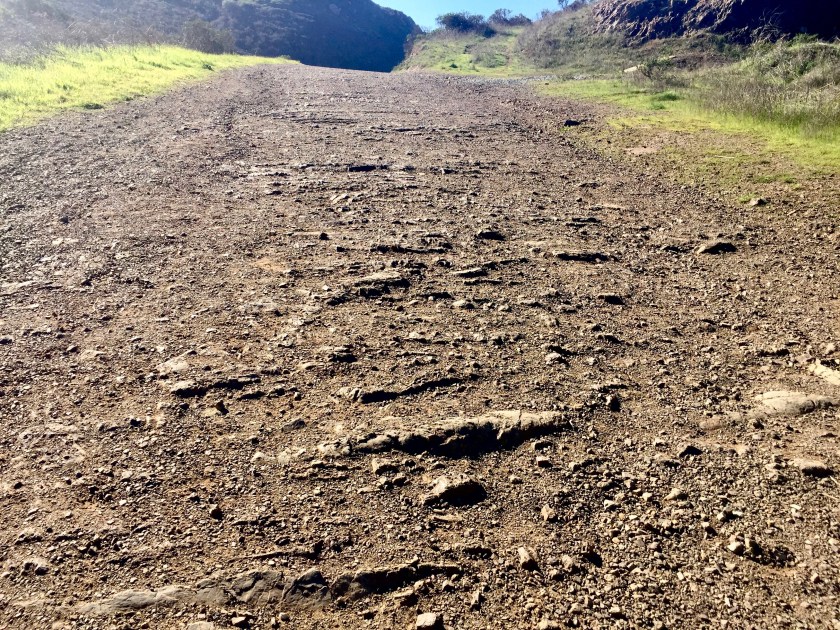
I saw a third wall of stone.  This one had toppled flat and become a sort of natural paving.  It was worn, barely visible.  I squinted to make it out, a fossil of its former grandeur.  The stone said, “Do not pity me in my humility.  All creatures who pass must walk on me and most don’t even notice, unless they stumble.  But I get to feel the weight of their sorrow and the spirit of their joy.  I have become the Earth.   And all manner of thing shall be well.”

img_6516

So that’s where St. Julian of Norwich got it, that anchoress sealed away in the walls of her church:  the stones told her.  All shall be well and all shall be well and all manner of thing shall be well.

Sitting with a sister creature

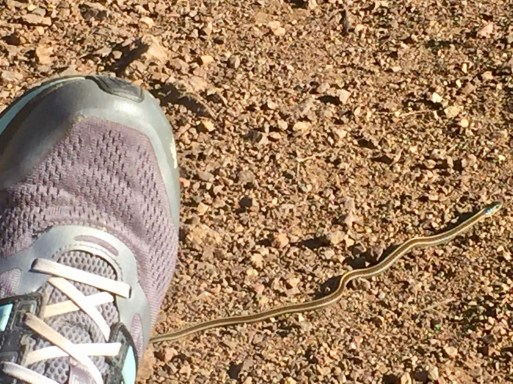
I was walking along the Tennessee Valley Trail trying out James Finley’s suggestion for mystic contemplation, inhaling the Universe’s goodness with “I love you” and exhaling back my own “I love you.”  I glanced down and there in the center of the path stretched the tiniest garter snake I had ever seen.   She did what snakes usually do: bolted for the grass on the side of the path.  But then, she stopped.  She just stayed there on side of the trail.  I stood for a long time, watching her.  Then I wondered if she would mind if I sat down.

img_6466

I sat down.  The snake stayed.  There we were, two sister creatures, two vestiges of God’s creation, as St. Bonaventure says.  We enjoyed the same sun on our backs.  We both put our faces to the breeze.  The snake slowly waved her head back and forth.  I wondered what garter snakes eat when they are too tiny to eat a mouse.   I exhaled, “I love you.”  She exhaled, “I love you, too.”

I stuck my foot out from where I was sitting and took this picture just so you could see how tiny this snake was.

img_6470

It was a busy day on the trail.  People tramped by talking politics and relationships.  The snake and I just stayed.

Finally, slowly, slowly, she crept into the grass; so slowly that I had to watch for a while to see her progress.  I couldn’t actually see her move. And then, with a sudden silent whoosh, she was gone.

img_6475
And I continued on my way.

img_6478

Starting the walk

What happens when we start to look at the space between?

On my first day at Richard Rohr’s Living School in Albuquerque, New Mexico, I sat in a circle of strangers (soon friends) as everyone described his or her contemplative practice.  We had yoga, Centering Prayer, chanting, sitting meditation, surfing, even drinking coffee, but when we came to John from New Zealand, he said that when he does a walking meditation he tries to look at the space between the branches instead of the branches themselves.   That was it.  One sentence.  Ah, thought I, what we called in art school the “negative space.”

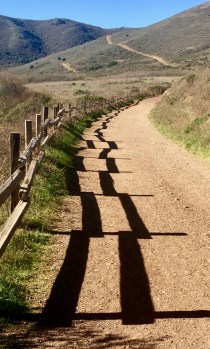
So, out I was on my daily walk near my home in Northern California and I snapped a cellphone photo of an old favorite dog-walking path to send to our daughters in New York City.  It was an ordinary photo of an ordinary, if beautiful, day, meant only to document a place and time.

image1

As I walked on, I decided to try John’s method of looking at the space between the objects.   I peered at the patterns between the branches.  I inhaled the air I shared with the shrubby landscape.  I gazed deeply into, well, what I usually think of as “nothing.”

And suddenly I was drinking a deeper world.  I had tumbled into a liminal space.   The earth was connected to me and I to it in a profoundly new way.  I was on a different walk.  I had found my practice.

I wanted to see if I still saw what I thought I had seen once I was off the trail, so I took a few pictures on the way back.

image4-2

image3

image2

Do you see it?